

If your dog is anything like mine, the hardest part of the day is the first ten minutes after he gets up. Biscuit is a 10-year-old golden retriever, about 74 pounds, and on cold mornings he comes down the stairs one careful step at a time. He used to bound. Now he pauses at the bottom, stretches his front legs, and gives me a look that says he is not quite ready to be a dog yet. That is what morning stiffness looks like, and it is the reason I started reading about green lipped mussel in the first place.
I am a retired school librarian, so my instinct when something worries me is to check things out of the library, read the labels, and ask our vet before I change anything. That is exactly what I did before we tried Zesty Paws Mussel Mobility Bites. This is the plain-spoken version of what I learned, how we used them, and what I actually noticed over about four months.
The soft chew we give Biscuit every morning with breakfast
Zesty Paws Mussel Mobility Bites combine New Zealand green lipped mussel with natural glucosamine and chondroitin, and they are soft enough to hide in a bowl of kibble. If your dog is slowing down on cold mornings, this is the place we started.
Amazon Check Today's Price on Amazon →Step 1: Talk to your vet before you change anything
I know it is tempting to skip this step. The internet is full of people who will happily tell you exactly what to feed your dog, and some of them mean well. But stiffness can be caused by a lot of things, and a supplement is only helpful if it is aimed at the right problem. Our vet listened to how Biscuit was moving, watched him walk down the hallway, and agreed that his hips and elbows were stiff but that he was otherwise healthy. That visit gave me a baseline, and it also gave me permission to try something conservative before we talked about anything stronger.
Ask your vet about your dog's weight, too. Extra pounds make every stiff joint work harder, and our vet reminded me that Biscuit's 74 pounds is right at the top of the range for a golden his size. We are careful with treats, and the mobility bites themselves are small enough that two of them do not feel like a meal. The point is not to guess. The point is to start from a clear picture of what is going on.
One more thing: tell your vet exactly which supplement you are considering. The label on Zesty Paws Mussel Mobility Bites lists green lipped mussel, glucosamine, chondroitin, and omega-3 fatty acids, and your vet will want to know those ingredients so they can check for anything that might interact with your dog's health history. Ours gave a simple yes, and that was all I needed.
Step 2: Read the label like a librarian
I will confess that I read pet supplement labels the way I used to read a book before I put it on the shelf. I look at the source, the dose, and the fine print. The first ingredient that caught my eye on the Zesty Paws bag was New Zealand green lipped mussel. That is the whole reason I was there. Green lipped mussel is a shellfish that contains a natural combination of omega-3 fatty acids, chondroitin, and other compounds that are often studied for joint comfort.
The label also lists natural glucosamine and chondroitin, which are the two ingredients most people have heard of for joint support, plus omega-3 fatty acids. What I liked as a careful reader is that the chews are made in the USA and the company is specific about the mussel coming from New Zealand. That kind of sourcing detail matters to me, because green lipped mussel is not a generic ingredient. Where it comes from and how it is processed can change what is actually in the chew.
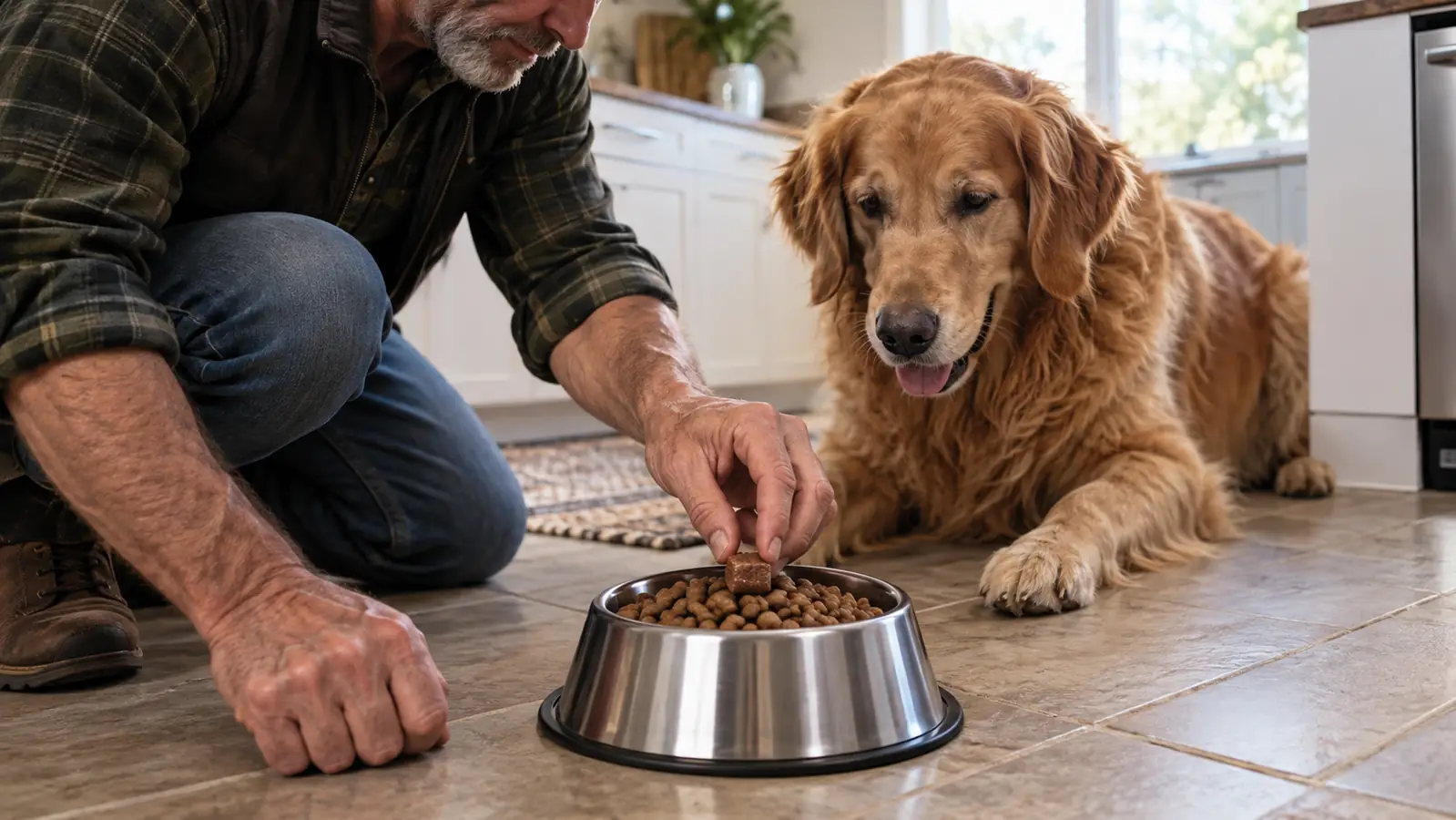
I also checked the feeding instructions before we started. For a dog Biscuit's size, the bag recommends two chews a day, and I give them with breakfast so they become part of the routine. The chews are soft, which matters for a 10-year-old dog who is pickier than he used to be. I have had to hide pills in peanut butter for years. These I just drop on top of his kibble and he eats them without a second thought.
If your dog has a known shellfish allergy, this is the point to stop and talk it through with your vet, because green lipped mussel is a shellfish. Biscuit has never had a problem, but I still watched his skin and his stomach closely for the first two weeks. I also checked that the dose on the label matched his weight rather than guessing from the size of the chew.
Step 3: Give it time and keep a simple record
Here is the part nobody likes to hear: supplements are not pain pills, and they do not work overnight. Green lipped mussel is the kind of ingredient that builds up in the body over weeks. I started Biscuit on the Zesty Paws chews in early November, when the mornings were just starting to get cold, and I did not expect to see a difference in the first week. I was right not to.
What I did instead was keep a tiny record. I am a librarian, so of course I kept a record. Every morning I noticed how Biscuit got down the stairs, whether he paused at the bottom, how he stepped into the car, and whether he asked to turn around early on our evening walk. I did not write essays. I just made a mental note, and sometimes a real note on the calendar, so I could look back honestly instead of trusting a rosy memory.
Somewhere around the third week, I realized he was not pausing at the bottom of the stairs as long. It was not a dramatic change. He still took the stairs like a careful old gentleman, but the hesitation was shorter, and he seemed more willing to get up from his bed when I reached for his leash. That is the kind of small, gradual shift that is easy to miss if you are not looking for it, which is exactly why I recommend keeping some kind of record.

Step 4: Pair the supplement with gentle movement
A chew cannot do all the work, and I do not think Zesty Paws would claim it could. The other half of what helped Biscuit was keeping him moving. On cold mornings I shortened our walk to the end of the block and back, just enough to let him stretch his hips and elbows without pushing him too hard. By the afternoon, when he was warmer, he was ready for his usual loop.
I also made one small change inside the house. We live in a two-story house with a steep set of carpeted stairs, and Biscuit has always slept upstairs with us. I put a nonslip mat at the bottom of the stairs and another one in the kitchen where he stands to wait for his breakfast. It sounds like a small thing, but a dog with stiff hips does not like to feel his feet slide, and the mats gave him more confidence on the days when he was slowest.
Small changes like that add up. A dog who is not bracing on a slippery floor every time he stands is a dog who is saving a little effort for the walk, and that is the whole point of the routine.
The routine we landed on was simple: two Zesty Paws chews with breakfast, a short and gentle walk in the morning, a normal walk in the evening, and plenty of soft places to lie down. Consistency mattered more than any single change. The chews only help if they are in his system every day, and the movement only helps if it happens every day, even on the days when he seems fine.
Step 5: Watch for what changes and what does not
After about four months, here is what I can honestly say. Biscuit still has stiff mornings. He is a 10-year-old golden retriever with hips and elbows that have carried him for a long time, and no supplement is going to make him a puppy again. What changed is the edge of it. He gets up more readily, the first few steps are less careful, and he has not needed my help getting into the car since early December. Those are real differences, and they are the ones I care about.
I also watched for things that did not change. He still prefers his bed to the hard floor. He still takes the stairs one at a time. And on the coldest mornings, when the temperature drops below zero the way it does in Green Bay, he is still slow. I mention that because I think it is important to have honest expectations. Green lipped mussel is not a cure. It is a daily comfort measure, and for Biscuit it has been a worthwhile one.
If you start your dog on Zesty Paws Mussel Mobility Bites, give it a full month before you decide anything. Take a note of how your dog moves today, then check again in four weeks. If you see the same small shifts I did, you will know the answer for yourself. And if you do not, talk to your vet about what else might be going on. That is the honest version of this whole process.
What Else Helps
The green lipped mussel chews are the centerpiece of our morning routine, but they work best alongside a few other things. A warm, soft bed matters more than I expected, especially in winter. I also switched Biscuit to a raised bowl in the kitchen so he does not have to bend as far to eat, and I try to keep his weight steady because every extra pound is extra work for stiff joints. Gentle massage on his hips after a walk seems to help him settle, and our vet has always said that consistent, moderate exercise beats the weekend warrior approach. None of these things is dramatic on its own. Together, they made the mornings noticeably easier.
Somewhere around the third week, I realized he was not pausing at the bottom of the stairs as long. It was not dramatic, but it was real.
Start with the chew that made our mornings easier
Zesty Paws Mussel Mobility Bites are the soft chews we have used every morning since November. They are not a cure, but they are a simple, consistent part of a routine that helped Biscuit move more easily. Check the current price on Amazon and see if they fit your dog's morning.
Amazon Check Today's Price on Amazon →