
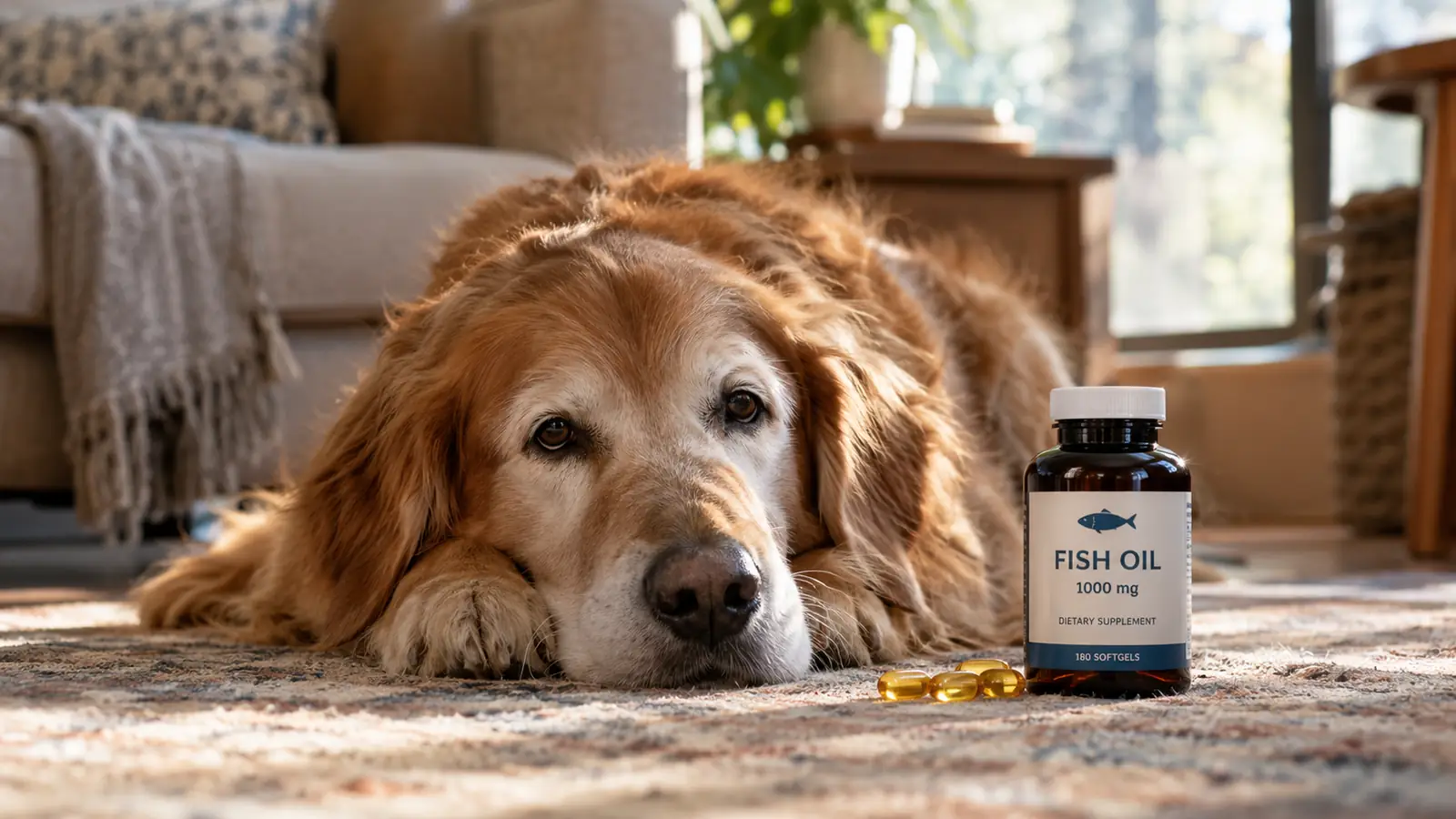
If your dog is anything like mine, the mornings have gotten a little slower. Biscuit is a 10-year-old golden retriever, about 74 pounds, and for the past couple of winters he has been stiff in the hips and elbows when he first gets up. He still loves his evening walk around the block, but the stairs in our two-story house have become a negotiation. Our vet suggested we try an omega-3 fish oil, and after a lot of label reading, we settled on Nordic Naturals Omega-3 Fish Oil for Dogs. This is how we give it to him, step by step, and what I wish someone had told me before we started.
I am a retired school librarian, which means I read labels the way other people read novels. I wanted to know exactly what I was giving Biscuit, how much, and whether it was actually doing anything. What follows is the routine we landed on with our vet, the mistakes we made in the first week, and the honest results after a few months. If you have been standing in the pet supply aisle wondering whether fish oil is worth the trouble, this is the article I was looking for.
The fish oil we give Biscuit every morning
Nordic Naturals Omega-3 Fish Oil for Dogs comes in softgels that are easy to hide in breakfast. It is the bottle we have reordered three times, and the one our vet was glad to hear about.
Amazon Check Today's Price on Amazon →Step 1: Ask your vet for a dose, not a guess
Before I bought anything, I called our vet and asked two questions: should Biscuit be on fish oil at all, and if so, how much? The answer to the first was yes, because his stiffness was starting to affect his quality of life. The answer to the second was more specific than I expected. Our vet calculated a dose based on Biscuit's weight, about 74 pounds, and told me to look for a product that gave a clear amount of EPA and DHA per serving. She also asked about his other medications and his thyroid test from the fall, because fish oil can interact with some things, and she wanted his bloodwork to be current before we added anything new.
This matters more than people think. Fish oil is one of those supplements where the dose is the whole game. Too little and you are not giving the dog anything meaningful. Too much and you are wasting money or, worse, giving your dog an upset stomach. The Nordic Naturals bottle lists the EPA and DHA right on the back, which is exactly what our vet wanted to see. If your vet gives you a number, write it down. That number is your target.
One more thing I learned the hard way: tell your vet which brand you are planning to use. Different products have different concentrations, so the number of softgels can vary even when the dose is the same. Our vet was able to tell us exactly how many Nordic Naturals softgels to give Biscuit per day, and that took all the guesswork out of it. I wrote the number on a sticky note and taped it to the bottle, because I knew I would forget it by the time the bottle arrived. That sticky note is still there, slightly smudged from six months of kitchen steam.
Step 2: Start with a lower amount for the first week
The first mistake I made was giving Biscuit the full dose on day one. He had a loose stool that afternoon, and I spent the evening feeling like a bad dog owner. Our vet explained that a dog's digestive system sometimes needs a week to adjust to a new oil, especially a senior dog who has never had one. The fix was simple: start with half the softgels for the first five to seven days, then move up to the full amount. She told me to expect it to take about a week, and to call if he was still having trouble after day four.
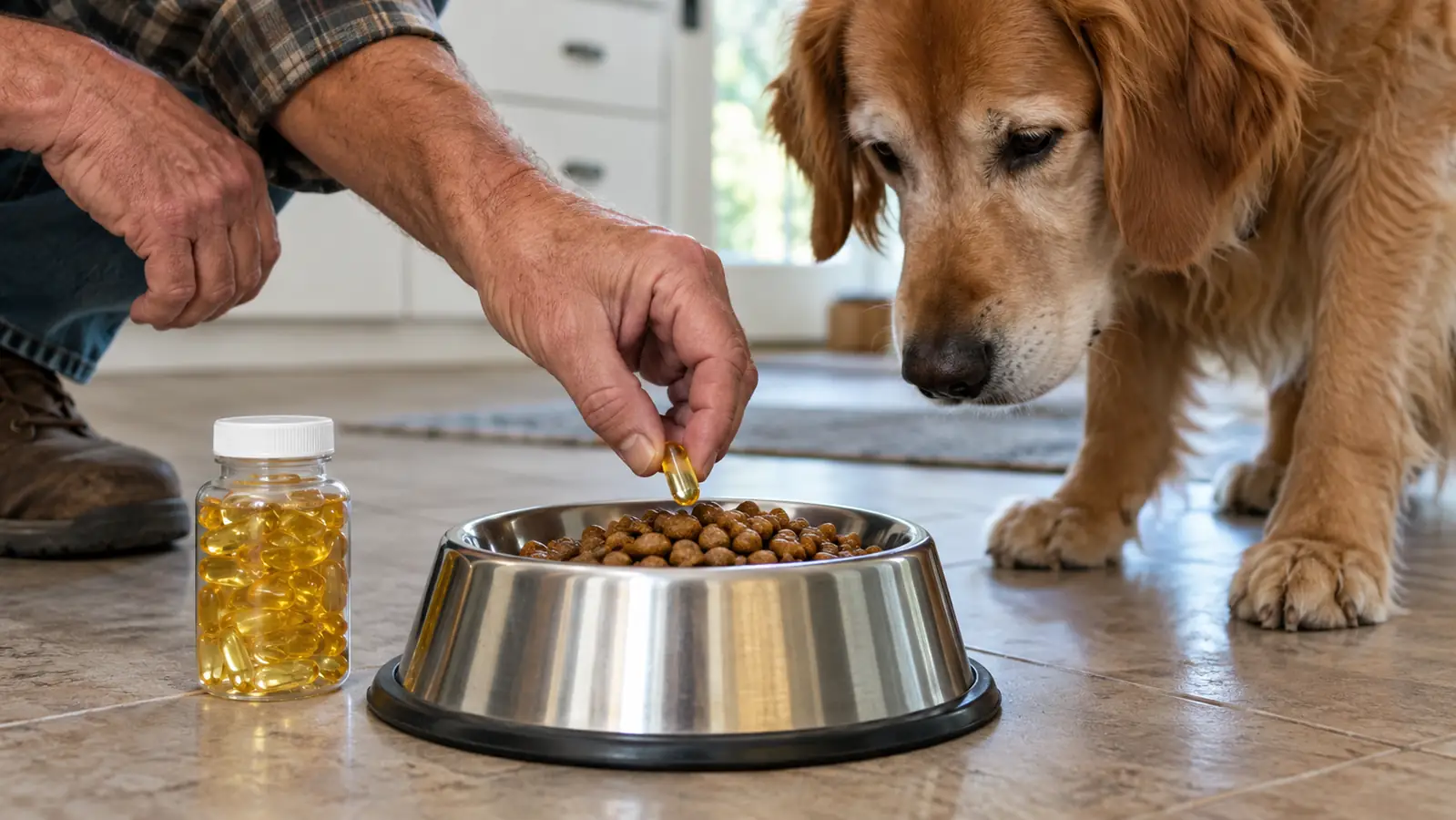
With Nordic Naturals, that meant giving Biscuit one softgel with breakfast instead of two for the first week. He did fine on the half dose, and when we moved up to the full amount, his stomach was already used to it. If your dog has a sensitive stomach, this ramp-up period is not optional. It is the difference between a supplement that becomes part of the routine and one that gets abandoned after three days. I marked the changeover on the calendar, a small circle around the date, so I would know exactly when he had been on the full dose for a full week.
I also learned to give the softgel with food, never on an empty stomach. Biscuit gets his with breakfast, tucked into a small spoonful of plain canned pumpkin or sometimes just buried in his kibble. The food seems to help his stomach handle the oil, and it makes the whole thing feel less like medicine and more like a treat. On the morning I tried giving it to him before his bowl was ready, he looked at me like I had lost my mind, so we went back to the breakfast routine and stayed there. That was a Thursday, and I remember it because I had to sweep a softgel out from under the kitchen table.
Step 3: Hide the softgel in something he already loves
Biscuit is not a picky eater, but he is not a fool either. If I hand him a softgel on its own, he sniffs it, licks it, and leaves it on the kitchen floor. The trick that works every time is to bury the softgel in a small amount of something he already loves. For us, that is a spoonful of plain canned pumpkin mixed into his breakfast kibble. The softgel disappears before he even notices it. I have watched him do it a hundred times, and he never chews it, he just swallows it with the pumpkin.
If your dog does not like pumpkin, there are plenty of other options. A little plain yogurt, a smear of peanut butter, a piece of cheese, or even a commercial pill pocket all work. The key is to use just enough to hide the softgel, not so much that you are adding a whole extra meal to his day. Biscuit is 74 pounds and does not need the extra calories, so I keep the hiding vehicle to a spoonful. I measured it once, just to be sure, and a level spoonful of pumpkin is about the size of a golf ball. A friend of mine uses a single slice of American cheese folded around the softgel, and her dog thinks it is the best part of the morning.
One warning from personal experience: do not crush the softgel or poke a hole in it to squeeze the oil onto the food. The oil tastes strong, and once Biscuit tasted it straight, he looked at his bowl with real suspicion for two days. The whole point of a softgel is that the dog swallows it without tasting the oil. Let the softgel do its job. I learned that lesson on a Tuesday morning in February, and I have not repeated it since. I also learned to wash my hands right after, because the oil leaves a smell that Biscuit can detect from across the room.
Step 4: Give it at the same time every day, with breakfast
Consistency is the part nobody talks about. Fish oil is not a pill that works overnight. It is a fatty acid that builds up in the body over weeks, and the benefits only show up if the dog gets it every single day. We give Biscuit his Nordic Naturals softgel with breakfast, every morning, no exceptions. It takes about ten seconds, and it is now as much a part of the morning routine as his walk. When the time changed in the spring, I had to remind myself that his breakfast time did not change, only the clock did.
I keep the bottle in the kitchen, right next to his food, so I cannot forget it. The bottle has a child-resistant cap, which is good because my grandkids visit, and it stays fresh on the counter for the few weeks it takes us to go through it. I also write the date I opened it on the label, because fish oil does go bad eventually, and an old bottle is not doing anyone any good. The first bottle lasted us about six weeks, which told me we had the dose right. The second bottle lasted the same, and that is when I stopped worrying about whether I was giving him too much.
If you miss a day, do not double up the next day. Just give the regular amount and move on. I asked our vet about this after I accidentally skipped a morning, and she said the worst thing you can do is try to catch up. The routine is about steady, daily consistency, not perfection. That was a relief to hear, because I had been ready to beat myself up over one missed softgel. I have missed exactly two mornings in six months, and both times I just gave him his regular breakfast dose the next day and did not think about it again.
Step 5: Give it six to eight weeks, then judge honestly
Here is the part I wish every review would say out loud: fish oil takes time, and the changes are small. We did not see a transformation in Biscuit. We saw a slow, gradual difference that became obvious around the six-week mark. He still has stiff mornings, especially when the temperature drops, but he gets up a little more easily, and he has stopped pausing at the bottom of the stairs the way he did in January. In February, he needed a nudge to get into the car. By April, he was hopping in on his own more often than not.
I keep a simple note on my phone: the date we started, the dose, and a few words about how Biscuit seemed each week. That note has been more useful than my memory, because the changes were so gradual that I might have convinced myself nothing was happening. Looking back at the notes, the pattern is clear. Fewer slow starts, less hesitation on the car ride, and a dog who still wants his evening walk even on cold nights. On the first day of March, I wrote down that he trotted to the door for his walk instead of walking, and that was the moment I knew we were onto something. I still have that note saved, and I still smile when I read it.
Our vet also reminded me that fish oil is not a cure for arthritis, and it is not a replacement for pain medication if a dog needs it. It is one tool in the toolbox, alongside gentle exercise, a warm place to sleep, and keeping his weight where it should be. We use Nordic Naturals because it is the product our vet was comfortable with and the one that has been easiest to give consistently. That consistency, more than anything else, is what made the difference. If you start this routine, give it the full eight weeks before you decide whether it is working, and keep notes so you can see what your memory might miss.
What Else Helps
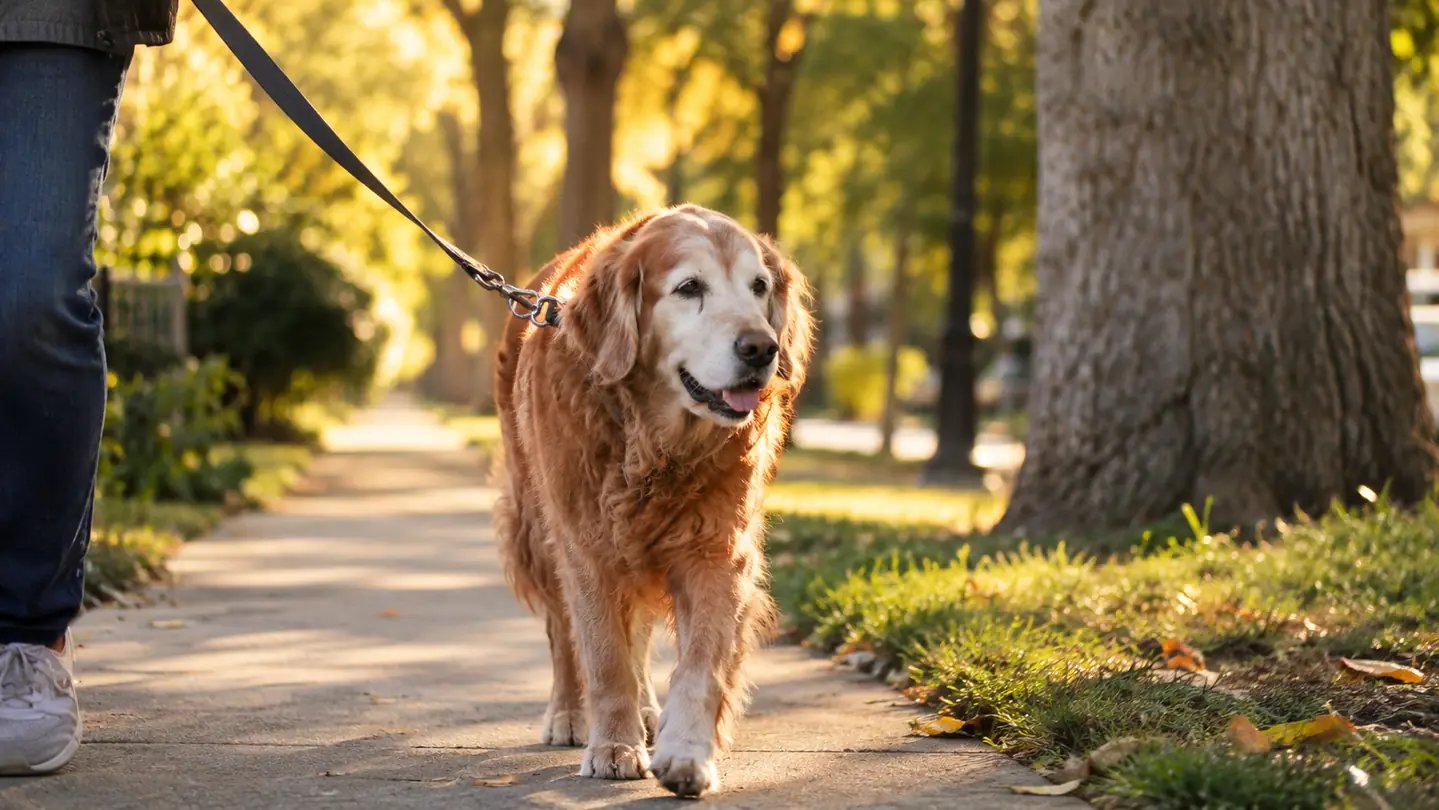
Fish oil works better when it is part of a bigger picture. For Biscuit, that means his morning and evening walks, even when they are short, because keeping him moving gently seems to keep him looser. It means a warm bed away from the cold floor in winter, and it means watching his weight, because every extra pound is extra work for those hips. We also added a joint supplement with glucosamine and chondroitin after talking to our vet, and the two seem to complement each other. If you are thinking about fish oil for your senior dog, do not stop at the bottle. Look at the whole routine, and ask your vet what else might help.
The changes were so gradual that I might have convinced myself nothing was happening. Looking back at my notes, the pattern was clear: fewer slow starts, less hesitation on the stairs, and a dog who still wanted his evening walk.
Start your senior dog on the same routine we use
Nordic Naturals Omega-3 Fish Oil for Dogs is the bottle we have reordered three times. Give it with breakfast, stay consistent, and judge the results after six to eight weeks, the way our vet suggested.
Amazon Check Today's Price on Amazon →