

The first cold morning last October, Biscuit stood at the top of the stairs and looked down at me like he was doing the math. He is a 10-year-old golden retriever, about 74 pounds, and for the past couple of years his hips and elbows have been stiffest on those mornings. He still loves his evening walk around the block, but the getting-up part has gotten slower. Our vet explained that part of the stiffness comes from joint fluid thinning with age, and that some dogs do better when that fluid gets a little extra support. That is how we ended up trying LubriSyn HA, a liquid hyaluronic acid supplement for pets.
I am a retired school librarian, so I read labels the way other people read novels. Before I gave Biscuit anything, I wanted to understand what hyaluronic acid actually does in a joint, how LubriSyn delivers it, and whether the whole idea held up. This article is the plain-spoken version of what I learned, plus how we used it, what I watched for, and what I would tell a friend who asked.
Supporting Biscuit's Joint Fluid Started With One Pump a Day
LubriSyn HA is a liquid hyaluronic acid supplement you can add to your dog's breakfast. It is the product we have used every morning since October, and it is the one I would start with if I were you.
Amazon Check Today's Price on Amazon →Step 1: Ask Your Vet Before You Change Anything
I know this sounds like the boring part, but it is the part I would not skip. Biscuit has mild arthritis in his hips and elbows, and he takes a prescription pain medication on the worst days. I wanted to know whether adding a supplement could interfere with that, and whether his kidneys and liver were healthy enough for a new addition to his routine. Our vet said yes, LubriSyn was a reasonable thing to try, and that the biggest risk was probably my own patience, because supplements do not work overnight.
Your vet knows your dog's bloodwork, weight, and medical history. A supplement that is right for one dog may not be right for another, especially if your dog has a chronic condition or takes other medications. A five-minute phone call is worth the peace of mind.
One more thing I learned: our vet said to keep using the prescription medication as needed and to think of LubriSyn as support, not a replacement. That framing helped me set realistic expectations from day one.
When I went in, I brought the bottle itself and a short list of everything else Biscuit was taking. That included his flea and tick prevention and the occasional fish oil capsule. Our vet looked over the label, asked how much he weighed that month, and told me which signs would mean we should stop and come back in. It took ten minutes and it gave me a lot more confidence in what I was doing.
Step 2: Understand What Hyaluronic Acid Does in a Joint
Hyaluronic acid is a molecule that occurs naturally in the body, and it is a major part of the synovial fluid that cushions joints. That fluid acts like a shock absorber between the bones, and it also helps lubricate the cartilage so the joint moves smoothly. As dogs age, the quality and quantity of that fluid can decline, which is one reason an older dog might feel stiff after lying down for a while.
LubriSyn is a liquid supplement that provides hyaluronic acid in a form the body can absorb. The bottle we use also includes MSM, which is another ingredient often used for joint support. The idea is to give the body more of the building blocks it needs to maintain healthy joint fluid, rather than trying to mask the discomfort.
I am not a veterinarian and I am not going to pretend to be one. What I can tell you is that the explanation made sense to me, and that our vet confirmed the basic science. If you want the full technical breakdown, the LubriSyn website and your vet are better sources than I am.
What I took from my reading is simple. Healthy joint fluid is part of what lets the surfaces of a joint move smoothly, and as dogs age, the joint can change in ways that make movement feel stiffer. A hyaluronic acid supplement is meant to support that system over time. It is not a painkiller, and it is not going to undo arthritis, which is why I think of it as one part of a routine rather than the answer to everything.
Step 3: Start With the Right Dose and Give It With Breakfast
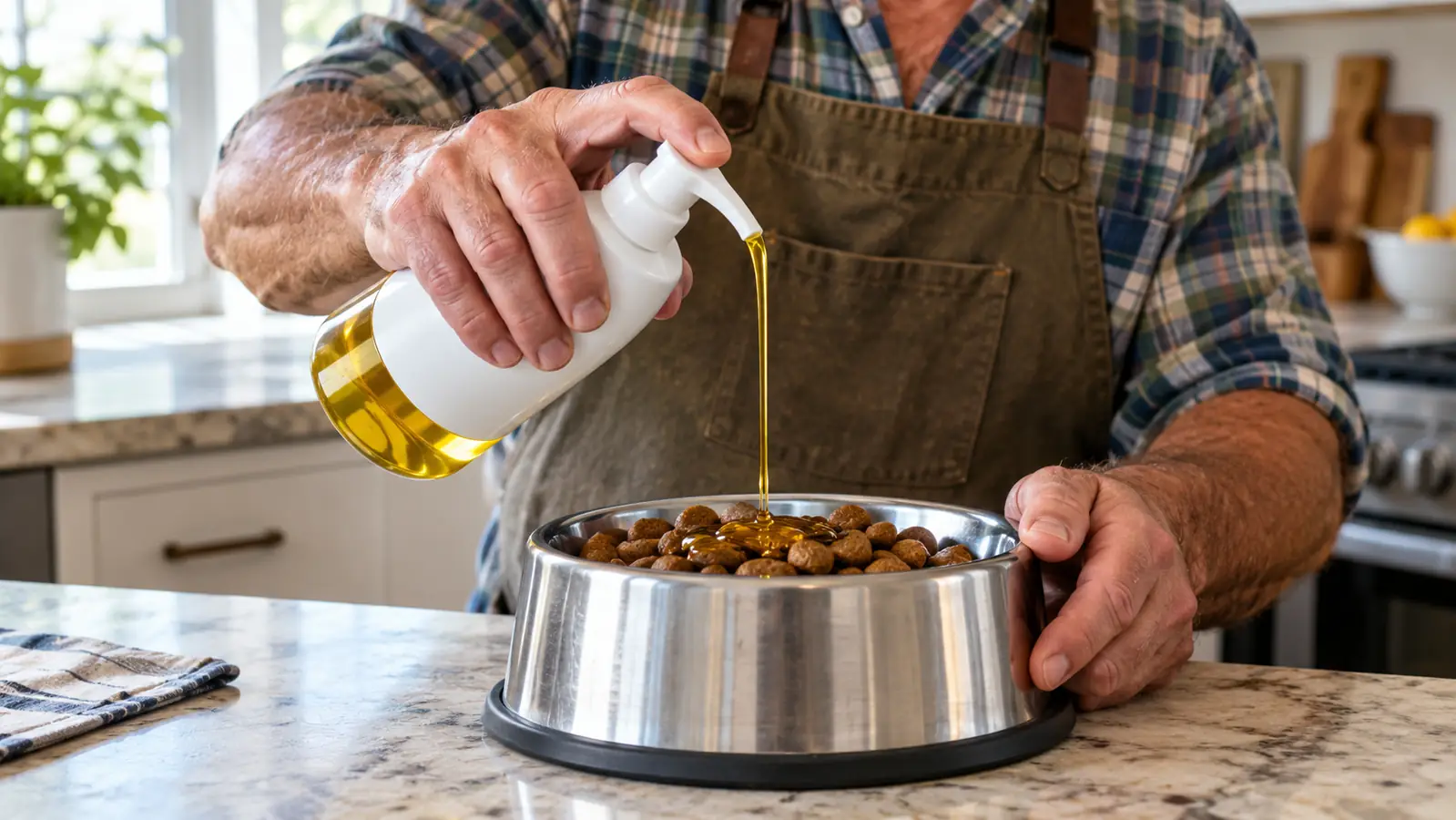
LubriSyn comes in an 8-ounce pump bottle, and the dosing is based on your dog's weight. For Biscuit, at about 74 pounds, the recommended amount was one full pump per day. I give it to him with breakfast, right on top of his kibble, and he licks the bowl clean. The liquid has a mild taste that he does not seem to mind at all.
The pump makes it easy to be consistent, which matters more than people think. A supplement only works if you actually give it every day, so I put the bottle next to his food container. That way I cannot forget it, even on mornings when I am still half asleep.
If your dog is a picky eater, you can mix the liquid into a small amount of wet food or a spoonful of plain yogurt. The goal is to get the whole serving into the dog, not to make a production out of it.
We settled on breakfast because that is when everything else in his routine happens. I pump the dose over his kibble, stir it in with a spoon, and set the bowl down. Biscuit has never once left any of it behind. If your dog eats wet food, it mixes in even more easily. Just try to keep it at the same meal every day so it becomes a habit for you and not something you have to remember.

Step 4: Give It Time and Keep a Simple Log
Here is the part I had to remind myself about: supplements are not pain pills. They work gradually, and the changes can be subtle. I did not see a difference in three days, and I did not expect to. What I did instead was keep a small notebook where I jotted down a few things each week: how easily Biscuit got up from his bed, how he handled the stairs, whether he hesitated before jumping into the car.
After about three weeks, I noticed he was getting up from his bed in the morning with less of a pause. After six weeks, he was taking the stairs at his normal pace more often than not. It was not a dramatic transformation, and I do not want to oversell it. It was more like the stiffness that used to last the first half hour of the day started to fade a little sooner.
A log helps you notice those small changes, and it also helps you have an honest conversation with your vet later. If you can say, 'He was slow on the stairs for the first two weeks, then he improved,' that is more useful than 'I think he seems better.'
My log was nothing fancy. Each morning I wrote one line: how long it took him to get up from his bed, whether he paused at the bottom of the stairs, and whether he wanted the long loop or the short loop on our walk. After a month, those short lines told me far more than my memory did. Memory always remembers the worst morning and forgets the ordinary ones.
Step 5: Watch for Changes and Reassess With Your Vet
No supplement works for every dog, and it is important to watch for signs that something is not right. If your dog's stiffness gets worse, if he seems uncomfortable, or if he has any digestive upset after starting a new supplement, stop and call your vet. I also think it is worth checking in with your vet after a month or two to decide whether the supplement is earning its place in the routine.
Set a date to reassess before you start. I marked mine on the kitchen calendar, about six weeks out, and wrote down the three things I was watching: how long Biscuit took to stand up from his bed, whether he stopped at the bottom of the stairs, and how far he wanted to walk in the evening. When the date came, I read back through the log, then talked it over with our vet. Having a set date stopped me from giving up too early on a slow week, and it also stopped me from carrying on for months out of habit if nothing had changed. A supplement should earn its place in the routine, and a clear check-in is how you find out whether it has.
For Biscuit, the answer was yes. We have used LubriSyn every morning since October, and I plan to keep going through the winter, which is always the hardest season for his joints. If I ever felt like it was not helping, I would say so, and we would stop.
One more honest note: LubriSyn is not a cure for arthritis, and no supplement is going to undo years of wear and tear. What it can do is support the joint fluid that helps your dog move comfortably. That is the goal we are aiming for, and it is a realistic one.
What Else Helps
A supplement is only one piece of the puzzle. The things that helped Biscuit the most, in order, were keeping him at a healthy weight, taking him on regular but not overly long walks, and keeping his nails trimmed so he does not slip on the hardwood floors. We also put a rug at the bottom of the stairs and a ramp-style step by the back door, which made a bigger difference than I expected. Our vet also mentioned that a warm bed in a draft-free spot helps on cold nights. None of these things replace a supplement, but they all work alongside it.
For Biscuit, that puzzle includes keeping his weight steady, trimming his nails so he can grip the floor, a rug runner on the slippery kitchen tile, and splitting one long walk into two shorter ones. None of those things cost much, and all of them make a supplement's job easier. I also bought him a firmer bed, because a mattress that sags makes getting up harder for an older dog with stiff hips.
After about three weeks, I noticed he was getting up from his bed with less of a pause. It was not dramatic, but it was real.
If You Are Thinking About LubriSyn, This Is the Bottle We Use
LubriSyn HA with MSM is the liquid supplement we have used every morning since October. It is easy to give, and it has earned its place in Biscuit's routine.
Amazon Check Today's Price on Amazon →