

If you have a senior dog, you have probably stood in the supplement aisle the way I did last fall, reading the back of a bottle and wondering whether any of it actually helps. My name is Ingrid, and my golden retriever Biscuit just turned ten. He is 74 pounds of mostly good manners, but the last couple of winters he has been slower on our stairs, and some mornings he gets up like an old man who slept wrong. Our vet said his hips and elbows are stiff, not broken, and that a joint supplement was worth trying. So I started reading labels the way I used to read library catalog cards, carefully and a little suspiciously.
What I kept coming back to was Zesty Paws Mussel Mobility Bites. The name is a mouthful, but the first ingredient on the label is New Zealand green lipped mussel, which our vet mentioned by name as one of the better-studied options for dogs with creaky joints. I bought a 90-count bag, started him on the chews with his breakfast every morning, and kept a little notebook of what I saw. This is my honest review after several weeks of real use, including the parts the product page does not tell you.
The Quick Verdict
A solid, well-made joint chew that helped Biscuit move more easily on cold mornings, but it is not a cure, it takes a few weeks to show anything, and the serving size adds up fast for a big dog.
Amazon Check Today's Price →If your dog is slowing down on the stairs, this is the chew I'd try first
Zesty Paws Mussel Mobility Bites combine green lipped mussel with glucosamine, chondroitin, and omega-3s in a soft chew most dogs eat like a treat. Check today's price on Amazon and see if it fits your dog's routine.
Amazon Check Today's Price on Amazon →How I've Used It
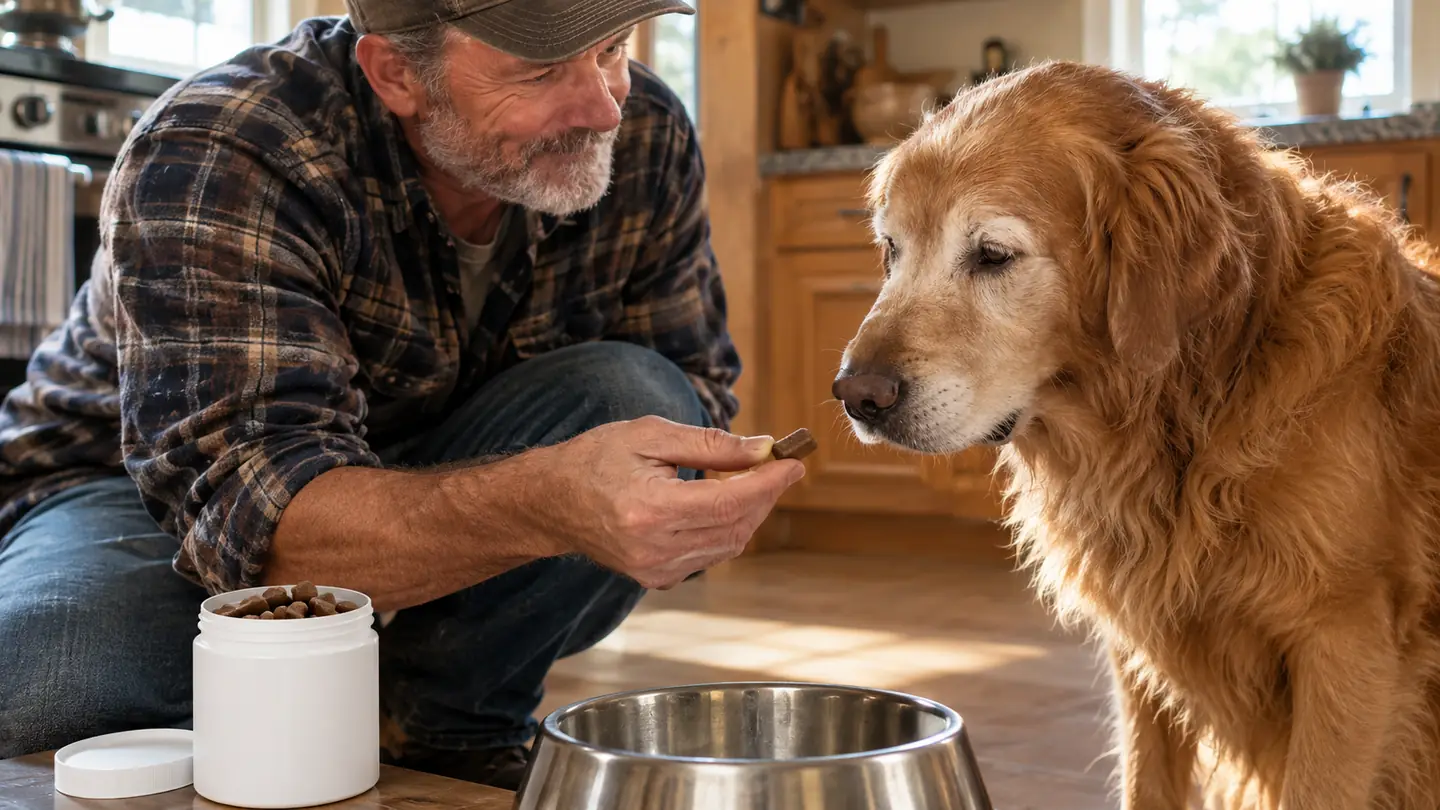
Biscuit gets his chews with breakfast, every single morning since we started on November 5th, a Tuesday. I remember the date because it was the day after our vet appointment, and I wanted to begin with her blessing fresh in my mind. The label has a serving chart by weight, and for a 74-pound dog it calls for two chews a day. I started with one for the first ten days, because I am cautious by nature and I wanted to see how his stomach handled it, then moved up to the full serving. The chews are soft enough to break in half, which mattered to me because he is a gulper, and I wanted to make sure he actually chewed it instead of swallowing it whole. The first morning he treated it like a treat, which is the honest truth, he had no idea it was supposed to be good for him. He just knew breakfast got more interesting.
I kept a simple routine: same time every day, same amount, no other new supplements. I also wrote down what I noticed each week in a small spiral notebook I keep on the kitchen counter, because I know myself, and I know I will convince myself something is working if I do not write it down. My entries are boring on purpose. Date, weather, whether he paused at the bottom of the stairs, whether he needed a boost into the car, how he walked on our evening loop around the block. The first week, honestly, I noticed nothing. Biscuit was the same dog, same pace on our morning walk, same careful way he sat down. I almost stopped then, and I am glad I did not, because the changes came slowly, the way most real changes do.
One thing I want to be clear about: I talked to our vet before starting this, and you should too. Joint supplements are not one-size-fits-all, and if your dog has a health condition or takes other medication, the label is not the last word. Our vet gave us the go-ahead, and that made it easier to be patient while we waited to see if it helped. She also told me to give it a full month before judging it, because joint supplements work slowly when they work at all. That turned out to be the most useful advice anyone gave me about the whole process, and I repeated it to myself every time I caught myself looking for a change that had not happened yet.
What Nobody Tells You About the First Few Weeks
The product page makes it sound like your dog will be doing zoomies by day three. The reality, at least for us, was quieter. The first real change I noticed was on the morning of November 19th, exactly fourteen days in. I was standing at the bottom of the stairs with my coffee, and Biscuit came down from the second floor without his usual pause. He used to stand at the top for a few seconds, as if he was bracing himself, and then take the steps one careful foot at a time. That morning he just came down, steady and unhurried, no pause at all. It was not dramatic, the kind of thing you would miss if you were not looking for it, but I wrote it in the notebook that evening, because that is the kind of small change I wanted to remember.
The second change was on cold mornings, which are the real test where we live in Green Bay. Last winter he would get up stiff and take a few slow, careful steps before he loosened up. This winter, after a few weeks on the chews, he still gets up a little stiff, but the slow part is shorter. It is not a transformation. It is more like the difference between a car that needs a minute to warm up and one that just needs a few seconds. One morning in early December it was nine degrees outside, frost on every window, and he came down the stairs, did his little morning stretch, and walked straight to the back door without the hobbling first lap he used to do. I stood in the kitchen and watched him, and I thought, "okay, that is different."
I also noticed he is more willing to jump into the car. He has never been a big jumper, but last year he would stand at the open door and wait for me to boost him. Now he often hops in on his own, not every time, but often enough that I noticed. The first time it happened was a Tuesday afternoon in late November, on our way to the vet for a routine checkup. I had my hand out to boost him, and he just jumped. I stood there with my hand in the air like a fool, and then I laughed, because that is exactly the kind of small, specific thing that tells me the supplement is doing something. It is not the kind of thing I would have imagined on my own.
The other change surprised me, because it was not about stairs or cars at all. It was about our evening walk around the block. Biscuit has always loved that walk, but last winter he would slow down about halfway and fall in beside me, his nose to the ground, doing the last few blocks at a gentler pace. A few weeks into the chews, he started pulling ahead again. Not much, but enough that I noticed the leash had tension in it for the first time in months. Our loop is about six blocks and takes us twenty-five minutes at his pace, and I wrote in the notebook that he finished the last block with his tail up. Small thing. But I noticed.
The change was not a transformation. It was more like the difference between a car that needs a minute to warm up and one that just needs a few seconds.
What's Actually in the Chew
The reason I chose Zesty Paws over a cheaper bottle was the ingredient list. The first ingredient is New Zealand green lipped mussel, which is the part of the formula that got our vet's attention. Green lipped mussel contains naturally occurring glucosamine and chondroitin, plus omega-3 fatty acids, and there is real research behind it for joint health in dogs. It is not a mystery ingredient, and I like that the label says exactly what it is. Before this bag, I had tried a cheaper glucosamine-only chew from the grocery store, the kind in the bright box by the register. Biscuit ate it fine, but after a month I could not point to a single change, not in the stairs, not in the car, not in the way he got up in the morning. I am not saying that product was bad, only that it did nothing I could measure, so I stopped buying it.
The chews also include natural glucosamine and chondroitin on top of the mussel, which is the classic combination for joint support, and omega-3s for inflammation. I am not a veterinarian, and I am not going to pretend to be one. What I can tell you is that the formula is transparent, the amounts are listed on the label, and our vet recognized every ingredient and approved it. That is more than I can say for some of the powders and potions I looked at. I tried a green lipped mussel powder once, because it seemed like the more economical route, and Biscuit refused it. He sniffed his breakfast bowl, walked away, and came back ten minutes later to eat around the powder. For a dog who eats everything, that was a statement. The soft chew solved that problem completely, because to him it is just a treat at breakfast.
One thing I appreciated: the chews are made in the USA, and Zesty Paws is a brand with a long track record in the supplement world. That does not guarantee anything, but it mattered to me when I was choosing between a brand I had heard of and a bag of mystery bites from an unfamiliar name. I am a careful reader, and I like knowing who made the thing I am feeding my dog. I also checked the bag for an expiration date and a lot number, because I am that person, and both were printed clearly. The Zesty Paws website lists contact information if you have questions, which sounds like a small thing, but it is the kind of transparency I look for after too many years of reading vague labels.

The Honest Downsides
Now for the part the product page leaves out. First, the serving size. For a dog Biscuit's size, that is two chews a day, and a 90-count bag lasts 45 days, not three months. You will be reordering roughly every six weeks, and that is a real cost to plan for. I set a reminder on my phone for the start of the sixth week, because I did not want to run out and lose whatever progress we had made while I waited for a new bag to arrive. When the new bag came, I checked the expiration date before I opened it, a habit I got into after one bad experience with a different supplement that arrived too close to its date.
Second, the chews are not a fix for a serious problem. If your dog has severe arthritis or a torn ligament, a supplement is not going to fix that, and anyone who tells you otherwise is selling something. Our vet was clear that supplements support comfort, they do not cure structural problems. Biscuit still has stiff mornings. One morning in late January, when the wind chill was below zero, he got up slow and took the stairs one careful step at a time, the way he did last winter. I wrote it in the notebook. The difference is that those bad mornings are rarer now, and when they happen, he shakes them off faster. That is worth something, but it is not a cure, and I would be lying if I said otherwise.
Third, the texture and the smell. The chews are soft, which is good for older dogs, but they are also a little sticky, and they leave a residue on your fingers. It washes off easily, but it is worth knowing if you are squeamish about touching things. I keep a paper towel by the treat jar, and that solves it. The chews also smell distinctly of fish, which should not surprise anyone, since the first ingredient is a shellfish. The smell does not bother me, but I fold the top of the bag shut and keep it in the pantry, because I would not want it sitting open on the counter.
The last thing nobody tells you is that you have to give it time, and you have to give it consistently. A chew here and there will not tell you anything. I gave Biscuit his dose every single morning for three full weeks before I felt confident writing anything positive in the notebook, and even then my notes were full of qualifiers. If you are the kind of person who wants results in a week, this may frustrate you. I am that kind of person, and it frustrated me. But the second and third weeks are where the story changes, and you only get to see that if you stick with the routine.
What I Liked
- Green lipped mussel is the first ingredient, with real research behind it
- Soft texture is easy for older dogs to chew
- Biscuit actually likes the taste, which makes daily dosing easy
- Transparent label with glucosamine, chondroitin, and omega-3s listed
- Made in the USA by a brand with a long track record
Where It Falls Short
- Two chews a day for a large dog means a 90-count bag lasts only 45 days
- Takes two to three weeks before you notice anything, if you notice anything at all
- Soft chews are a little sticky and leave residue on your fingers
- Not a cure for serious joint problems, and it will not fix structural damage
Who This Is For
Zesty Paws Mussel Mobility Bites are for the owner of a middle-aged or senior dog who is slowing down in small ways: hesitating at the stairs, taking a little longer to get up, walking a little more carefully on cold mornings. If your vet has said your dog has mild joint stiffness and a supplement is worth trying, this is a good place to start. It is also for dogs who are picky about supplements, because the soft chew texture and the taste made it genuinely easy to give Biscuit his dose every single day.
Who Should Skip It
If your dog has severe arthritis, a recent injury, or trouble walking that is getting worse, do not rely on a supplement. Go back to your vet and get a real diagnosis. This is also not the cheapest option on the shelf, and if you are on a tight budget, a green lipped mussel powder might give you more for your money, though you will have to mix it into food and hope your dog eats it. And if your dog is a gulper who swallows treats whole, you will want to break the chews into smaller pieces, the way I do for Biscuit.
The bottom line: it helped, slowly, and I'd buy it again
Zesty Paws Mussel Mobility Bites did not turn back the clock, but they made Biscuit's cold mornings easier, and that is exactly what I hoped for. If your dog is slowing down, check today's price on Amazon and talk to your vet about whether it fits your routine.
Amazon Check Today's Price on Amazon →